The Appearance of the Briard
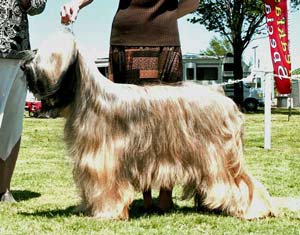 The coat is what the casual observer usually remembers about the Briard. The coat of an adult Briard is generally at least six inches long over the shoulder. A show coat on an adult dog can reach from twelve to eighteen inches, and flows when the Briard moves.
The Briard is a double coated dog. The outer coat is ideally a harsh, goat-like hair, and the undercoat is soft and dense. It is the double coat that makes grooming a challenge at times. The undercoat must be groomed to the skin, and lack of care leads to matting. A correct coat is MUCH easier to care for than a too-soft coat.
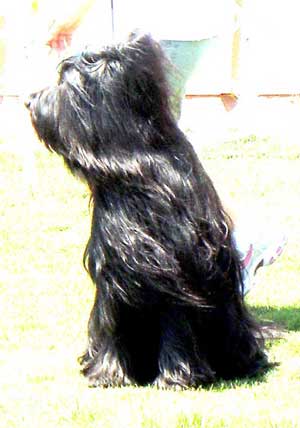
The Briard comes in many shades of tawny, black, and gray. It is okay to have more than one color on a dog, provided the change is gradual. Color changes with the age of a dog, sometimes dramatically.
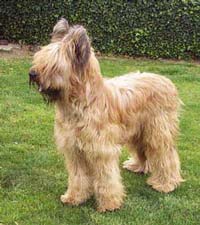 Tawny Briards can be almost white, a honey color, a very deep reddish tan, or any shade in between. They can have varying degrees of masking or overlay of darker tawny, black or gray. The change must be gradual, or the dog is considered a bi-color, which is not desirable. Briard can also be fairly "clear" (the coat is one color), with or without some black masking on the ears, beard, and tail.
Tawnies also can change color drastically over the course of their lives. They are born darker, and gradually go lighter until they are about two years of age. At that point, they begin to darken again, and reach their darkest color at about 4 years of age. 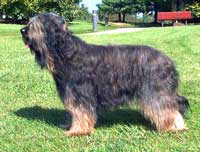 An overlay can be very prominent at one age, then virtually disappear. The standard states that the deeper shades of each color are preferred. White is not a correct color, although some Briards, especially at about 2 years, are such a light tawny as to look white. The dilute gene is consiered a major fault in Tawny Briards. This can be seen in a very pale color, with a lighter eye and nose color.
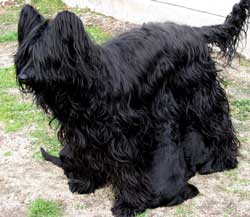 A black Briard also comes in many shades! True blacks have a glossy, blue-black coat, and they are getting harder to find in the US. True blacks can also come with white hairs intermingled with the black.
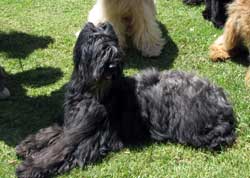 Black born grays are born black, but as they age, they develop varying amounts of gray or silver in the coat. The color can range from a slight charcoal appearance, to a silvering of the legs, ears, and beard, to a truly striking silver / black mixture over the entire body. Many blacks today carry the graying gene. When both parents carry this gene, puppies are more apt to be black born grays. They will have black noses, versus blues that may have lighter colored noses.
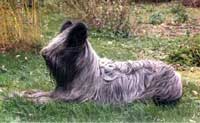 Gray born grays, sometimes known as blues, are the least common color. These Briards express the dilute gene in Blacks. They can be identified at birth, by the pewter color of the coat. In the US, the AKC standard calls for a black nose, and blues often come with a lighter nose color, and could be disqualified. In Europe, more of the true grays, the blues born with the color, are seen. As puppies, blues may have less undercoat than blacks. Unlike some other breeds, the blue color in Briards is not linked to any specific health problems.
Why choose one color over another? It's a matter of personal preference, but some broad generalizations can be made.
The Tawny color appears warmer, more open and friendly. When walking a Tawny Briard, even small children want to pet it, often acting as if it is a stuffed animal to hug and kiss. The Tawny expression is easier to see, and the variations in color give the dog more visual character.
The Black, on the other hand, appears more imposing and very elegant. People will stop to say wow!, and ask before petting it. Children recognize that it is a large dog, and are more hesitant to approach. With a Black, it mostly the outline that is seen, so a natural eared Black can appear to lack expression, unless viewed closely in good light.
Remember, it is only the appearance that is different. A tawny may look more open and friendly, but the character of the blacks and tawnies depends on the individual dog, not the color.
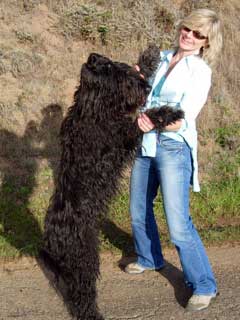 The Briard is a large dog. Bitches range from 22" to 25 ½" at the shoulder, weighing around 50 to 70 lbs. Dogs are larger, ranging from 23" to 27" at the shoulder, and usually weighing from 65 to 90+ lbs. Most today are at the upper end of the size range, and it is unusual to see a 50 lb female, or a 65 lb male. Briards appear larger than their actual size, because of the coat. Size has to relate to function, not just appearance. An oversize Briard would be unable to move with the speed and agility necessary to control a flock of sheep. An undersize Briard might lack the power necessary to face down and move a large, stubborn ram.
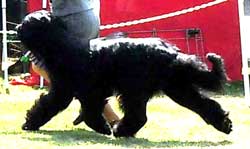 The Briard is a herding dog, and must be able to trot effortlessly during a hard days work with a large flock of sheep. A poorly structured Briard will not be able to cover ground for extended periods of time, or make the turns and stops necessary for herding. Watching the movement of a Briard can tell you as much about their structure as a diagram. A true quicksilver gait is a joy to watch, as the Briard covers ground effortlessly.
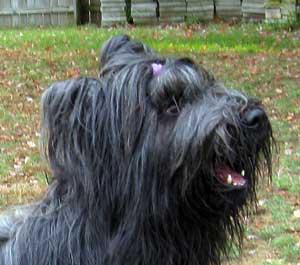 The head of the Briard is also a hallmark of the breed. It can be viewed as two rectangles, a larger one forming the skull and a smaller one the muzzle. The planes of the rectangles (the muzzle and the skull) should be parallel, separated by a stop. These are covered by a lot of coat! The beard and the arched hair veiling the eyes give the Briard head a very distinctive look. The head should always give an impression of strength, with good width and length.
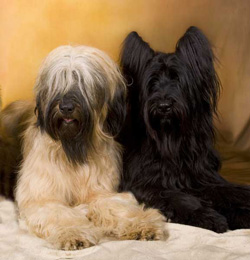 Ears can be natural or cropped. The cropped ear gives an alert look, the natural ear a sweeter look. Both can be shown, although in this country most Briards are cropped. Many experienced dog people do not realize that the Briard is a cropped breed, since until recently natural ears were a rarity. With the general ban on cropping in Europe, we are seeing more and more natural ears in this country. And some breeders and buyers have always preferred to keep ears natural.
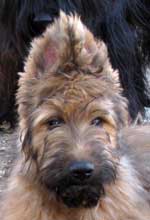 Cropping is done at a young age, usually about 6 - 7 weeks. The hair on the ears is then glued together with fabric glue. Ears remained glued until after teething, usually until 6-8 months. The methods for gluing vary greatly, with some breeders taking the ears apart regularly and regluing them, and others just adding more glue as needed. Cork, foam blocks, and molefoam are just some of the tools used by breeders. In France, traditional breeders used to sew the ears together along the inside edge, with pierced holes much like the pierced ears common on people. As the Briard gets older, sometimes the hair on the ears is tied together in lieu of gluing. Briards with poor ear leather (very thin skinned ears) are poor candidates for cropping, as the ears will not stand. Cropped dogs with fallen ears are sometimes called "crop & flops".
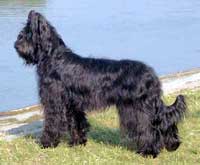 A very identifiable feature of the Briard is the tail, with a distinctive crochet, a "J", at the end. It is feathered, and the tip of the tail should reach the hock. A longer tail length is not penalized, and is often desired. Short tails, saber tails lacking the "J", ring tails that form an "O", and high set tails are all incorrect. When in motion, only the crook of the tail should be above the topline. The tail is a hallmark of the breed, one of the Briard's most distinctive and attractive characteristics
The most distinguishing feature of the Briard is at the end of the dog, and usually cannot be seen, it must be felt. There is a reason that the magazine for the Briard Club of America is called the Dewclaw.
Unlike most breeds of dogs that have a single rear dewclaw, the Briard has double dewclaws (extra toes) on the rear legs. Ideally, these are low on the leg, actually functioning as toes. There are many theories as to why the breed has kept these, but no one really knows. Within the AKC, only the Great Pyrenees, the Beauceron, and the Briard are required to have them. Unlike the single dewclaws on many other breeds, these are actual bony appendages, and removal is painful and unnecessary. Lack of the double dewclaws is a disqualification in any country. It is the first thing a breeder checks as puppies are born. The front legs occasionally also have double dewclaws.
Appearance Counts, But...
It is the personality and temperament of the Briard in general, and individuals in particular, that really matter when deciding if a Briard is right, and picking the right Briard for you.
I have refused to sell puppies to prospective homes that are so worried about if the ears will be black or tawny, they forget to ask what are the parents like? What do I expect from the litter?
So, look for the Briard that has the appearance you want, but never forget it is the brain and heart and love that determine if the dog is right for you!